Artificial Flower Wall Materials: Silk, PE and What to Buy
Artificial flower walls are judged in two very different conditions: from three metres away by a guest, and from thirty centimetres away by the client inspecting the sample. Materials that pass one test often fail the other, and the wholesale decision is about knowing which test your buyers actually apply.
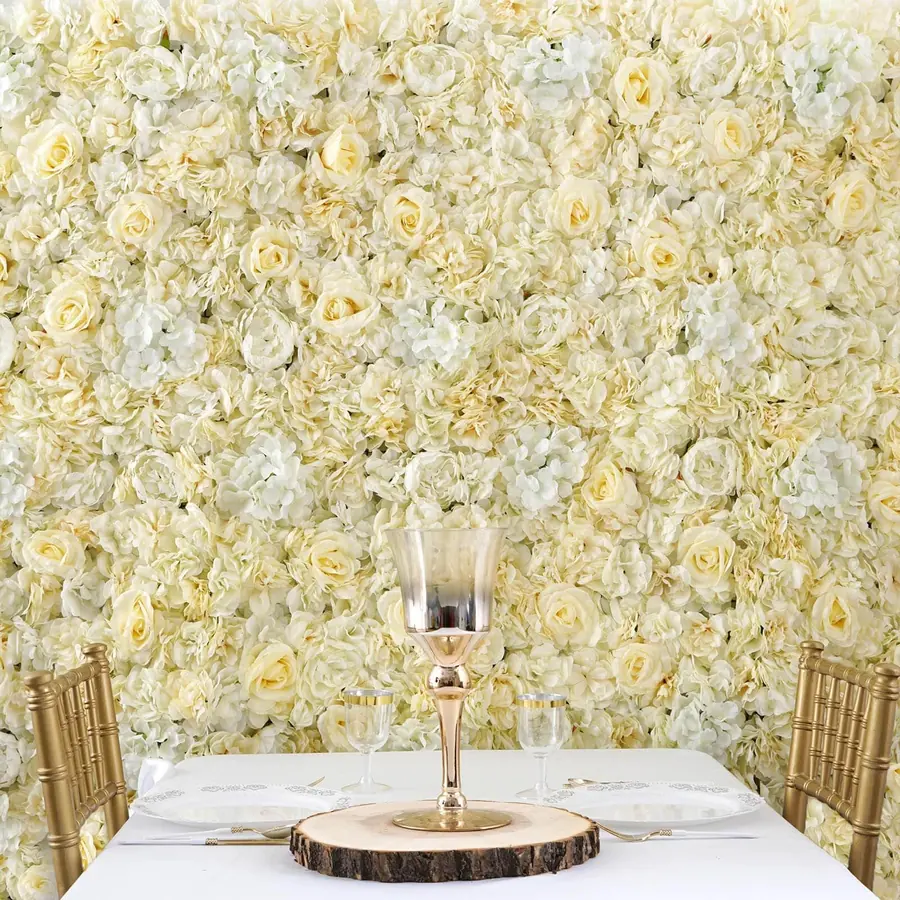
Silk, PE or latex: which artificial flowers should I buy?
Use PE for greenery and foliage, silk for visible blooms, and latex real-touch only for front-facing focal heads. A wall built entirely from one material is usually cost engineering rather than design.
Silk — in the trade this means polyester woven to a fabric-like hand, not true silk — is the standard for rose and peony heads. It takes dye well, holds a graded colour across the petal, and reads correctly at close range. It is also the most susceptible to fading under direct sun, which is why silk-heavy walls belong indoors.
PE, or polyethylene, is moulded rather than woven. The finish is more uniform and slightly plasticky at close range, but it is dimensionally stable, wipes clean, and survives outdoor use far better. Foliage, hydrangea heads and filler greenery are almost always PE for exactly this reason. Latex-coated 'real touch' heads sit at the top of the price range and are worth specifying only on the front-facing focal blooms where a client will touch them.
A well-built wall uses all three: PE greenery as the base mat, silk roses as the visible mass, and a small number of real-touch focal heads at eye level. Buying a wall that is entirely one material is usually a sign of cost engineering rather than design intent.
How do I judge the quality of an artificial flower wall?
Judge stem density, not head count. Low-density panels show the backing mat through the gaps, and no amount of head quality compensates for a visible grid.
The most reliable predictor of whether a flower wall looks expensive is stem density — how many heads per square unit of panel. Low-density panels show the backing mat through the gaps, and no amount of head quality compensates for a visible grid. When comparing two quotes at the same price point, density is almost always where the difference has been taken.
You cannot read density from a product photo shot straight on with soft lighting, because that is the angle at which a sparse wall looks its best. Ask for an angled shot or a photo under hard side light: gaps in the mat appear immediately. This is the single most useful question a buyer can ask a supplier and it is asked far too rarely.
- Straight-on soft-light photo: flatters low density, tells you little
- Angled or side-lit photo: reveals backing mat and gap distribution
- Close crop at petal level: shows dye grading and moulding seams
Can artificial flower walls be used outdoors?
For covered or short-duration outdoor use, yes. Sustained direct sunlight will shift the colour of silk blooms over a season regardless of manufacturer, so exposed installs should be quoted as consumable stock.
Most wholesale enquiries about outdoor use are really about two separate risks: fading and water. Fading is a dye and material issue, and PE greenery consistently outperforms silk blooms under UV. Water is a construction issue, because a soaked backing mat holds moisture against the stems and dries slowly.
Our position is straightforward: artificial flower walls are specified for indoor and covered outdoor use. Sustained direct sun over a full season will shift the colour of silk heads regardless of who manufactures them, and any supplier claiming otherwise is describing a product that has not been in the sun. Where a client insists on an exposed setup, quote it as consumable inventory with a shorter service life rather than as a long-term rental asset.
Why does my flower wall look flat when it arrives?
Because walls ship compressed to reduce freight volume. Hang the panels vertically and let the stems recover before judging or photographing them; reshape folded stems by hand from the base outward.
Flower walls ship compressed, because shipping air is expensive. The consequence is that they arrive flat and look worse than they will after fluffing. Every new reseller has the same first-unboxing reaction, and it costs suppliers a great many unnecessary complaint threads.
The remedy is procedural, not technical. Unpack on arrival, hang the panels vertically, and let them recover before photographing or judging them. Stems that have been folded in transit are re-shaped by hand from the base outward. A wall that has been hung for a few hours is the wall the client will see; the one straight out of the carton is not.
For rental operations, this argues for storing walls hung or loosely rolled rather than stacked flat under weight. Panels stored compressed between bookings need the same recovery time every single time, which becomes a labour cost on a same-day turnaround.
What should I check on a flower wall sample?
Five things: pull a head to test its fixing, bend a stem to see if the wire returns, inspect the reverse seam, compare colour between two panels, and rub a petal edge with a damp white cloth for dye transfer.
Five checks cover most of the risk. Pull one head firmly to test whether it is glued or mechanically fixed to the stem. Bend a stem to see whether the wire returns or stays kinked. Look at the reverse of the panel for how the mat is joined, because that seam is what shows on a multi-panel wall. Check colour consistency between two panels of the same colourway from the same order. And rub a petal edge with a damp white cloth to see whether dye transfers.
Our flower wall range runs from $129.00 to $179.00 across 13 products, and the price spread within a single visual style is almost entirely density and head quality. Sampling at MOQ 2 before volume is the cheapest insurance available in this category.
Frequently asked questions
Are silk flower walls suitable for outdoor weddings?
For covered or short-duration outdoor use, yes. Sustained direct sunlight will shift the colour of silk heads over time, so exposed permanent installs should be quoted as consumable rather than long-term rental stock.
Why does the wall look sparse when it arrives?
Walls ship compressed to reduce freight volume. Hang them vertically and allow the stems to recover before assessing or photographing. Folded stems are reshaped by hand from the base outward.
What is the difference between silk and PE flowers?
Silk (woven polyester) takes graded dye well and looks more natural at close range. PE is moulded, more uniform, more durable and more UV-stable. Good walls use PE for greenery and silk for visible blooms.
How do I compare two suppliers at the same price?
Compare stem density, not head count. Ask for an angled or side-lit photograph — a straight-on soft-light shot hides gaps in the backing mat.
Need a quote for your project? Send us your target quantity and destination port and we will come back with landed cost, not just unit price.