Fabric or Modular Shimmer Panels: What's the Difference?
A fabric shimmer backdrop is a continuous sequin curtain that hangs from a rail. A modular one is a grid of rigid interlocking squares. They photograph similarly and behave completely differently in a rental operation — the fabric version is faster to hang, the modular version is repairable one panel at a time.
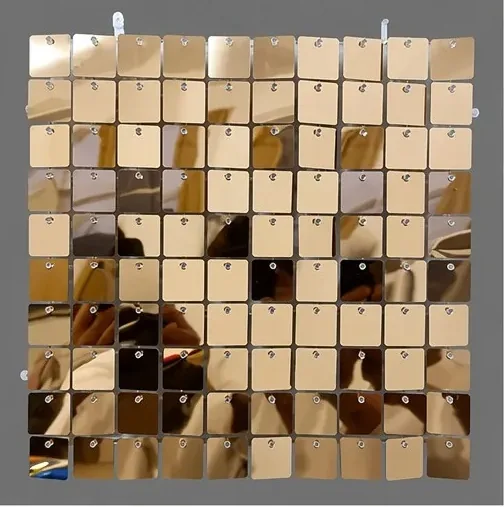
How are fabric and modular shimmer panels built differently?
Fabric versions are sequins stitched onto a flexible backing cloth, supplied as a single piece. Modular versions are sequins mounted on rigid squares that clip to each other, supplied 24 to a set at a standard panel size.
That difference determines everything else. A continuous cloth has no seams to align and no join lines in a photograph, but it also cannot be partly replaced — damage anywhere affects the whole piece. A panel grid has visible module lines up close, and any single damaged square lifts out.
Both types appear in our shimmer range, with modular making up the larger part of the 79 items we list. Solid modular panels are $1.59 each and patterned $1.99, which prices a repair rather than a replacement.
- Fabric: continuous sequin cloth, no join lines, one piece
- Modular: rigid interlocking squares, 24 to a set
- Fabric cannot be partly replaced; modular can
- Modular shows fine module lines at close range
Which type is faster to set up at a venue?
Fabric, clearly. A sequin curtain hangs from a rail or crossbar in one movement, while a modular wall has to be assembled square by square into a grid.
For a business doing several installs a day that time difference is real money. A fabric drop behind a dessert table is a few minutes of work; the same coverage in panels is a considerably longer build, and it needs a level base to stay square.
Modular earns its build time back on flexibility. The same panels make an 8ft wall, a narrow column or a band inside an arch, so one stock holding serves layouts a fixed-width curtain cannot. Fabric is faster at doing one thing; modular is slower at doing many.
- Fabric hangs in one movement from a rail
- Modular needs square-by-square assembly on a level base
- Fabric wins on multi-install days
- Modular wins where layouts vary between bookings
Which survives repeat rental handling better?
Modular, because damage is contained. When one square is marked or bent you replace that square at $1.59 and the wall goes out again looking new.
A fabric curtain concentrates risk in a single item. Sequin cloth catches on frames and zips during packing, and a pull or a bald patch anywhere on the piece affects the whole backdrop. There is no partial repair, so a single incident writes off the unit.
This is the main reason rental operators drift towards modular over time. The upfront convenience of fabric is real, but the replacement economics favour a system where the failure unit is one panel rather than one backdrop.
- Modular damage is contained to one square
- Single panel replacement at $1.59
- Fabric has no partial repair — one incident writes it off
- Sequin cloth catches during packing; panels do not
Does one photograph better than the other?
At normal photo distance they look the same. Both give the reflective, moving surface that the format is bought for, and neither reads as inferior in a finished image.
The difference shows in close-up and in raking light. A modular grid has fine lines where squares meet, which is visible in a tight portrait or when a light sits at a sharp angle across the wall. A fabric drop has no such lines but does show any sag in the hang.
Choose by the shot your customers actually buy. Full-length group photographs favour either; close-up portrait work and product photography favour the seamless fabric surface, while wide feature walls favour modular because the lines vanish at distance.
Which should a rental business buy first?
Modular, at the minimum of 2 sets. It covers more layouts, repairs cheaply, and scales into volume pricing that a fixed-width curtain cannot reach.
The exception is a business whose bookings are consistently identical. A photo studio hanging the same backdrop in the same place every day gets more value from the speed of a fabric drop, because the flexibility of a panel grid is capability it never uses.
For general event and party rental the layouts vary constantly, so modular is the safer opening purchase. Add a fabric drop later as a fast option for simple jobs, once you know how often those jobs come up.
- Modular first for general event rental at 2 sets
- Fabric first only for fixed, repeating setups
- Modular reaches volume tiers; single curtains do not
- Add fabric later as the fast option for simple jobs
Can fabric and modular be used together?
Yes, and they solve different problems in the same booking. A modular wall makes the main feature while a fabric drop covers an awkward gap, a doorway or a service area the panels cannot reach.
Fabric is also the better answer for curved or irregular runs. A panel grid needs a flat plane, so anything following a curve is easier in cloth — which is why the two together cover more venue conditions than either alone.
Keep colours matched if they appear in the same shot. Sequin finish varies between a rigid panel and a woven cloth, so pairing them in one photograph works best when the colour is the same family rather than a near miss.
Frequently asked questions
What is the difference between fabric and modular shimmer panels?
Fabric is a continuous sequin curtain hung from a rail; modular is a grid of rigid interlocking squares supplied 24 to a set. Fabric is faster to hang, modular can be repaired one panel at a time.
Which type lasts longer in rental use?
Modular, because damage is contained to a single square that replaces at $1.59. A fabric curtain has no partial repair, so one pull or bald patch affects the whole backdrop.
Do modular panel lines show in photographs?
Only in close-up or raking light. At normal photo distance the grid lines are not visible. Wide feature walls suit modular; close portrait and product work suits a seamless fabric drop.
Which should I buy first for an event rental business?
Modular at the 2 set minimum, because layouts vary between bookings and panels reach volume pricing. Choose fabric first only if your setups are identical every time, such as a fixed studio backdrop.
Need a quote for your project? Send us your target quantity and destination port and we will come back with landed cost, not just unit price.