Should You Order a Backdrop Sample Before Buying Wholesale?
Order a sample when colour accuracy or feel decides the purchase, and skip it when the specification already answers your question. Minimum order is 2 sets, which is low enough that a first order often serves as its own sample — that changes the calculation for most buyers.
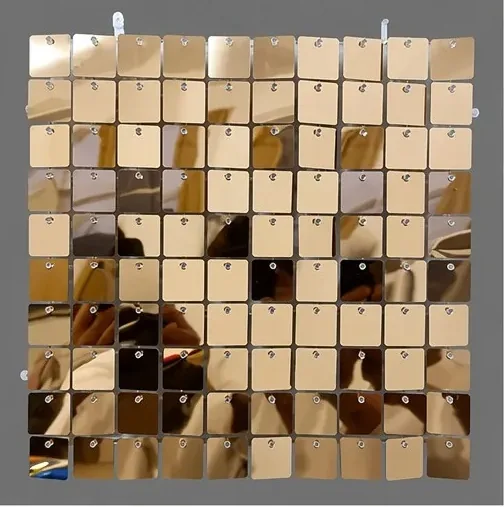
When is a backdrop sample order worth it?
When you are matching a colour, judging a finish, or committing to volume. Those are the three things a photograph cannot settle, and all three carry real cost if you get them wrong.
Colour is the most common reason. Screen rendering of a metallic or blush sequin varies by monitor, so a wall that looked champagne online can arrive distinctly gold. If you are matching existing stock or a client's scheme, a physical panel is the only reliable check.
The volume case is different. Before an order at the 500 panel tier, a sample is cheap insurance on a large commitment. Before a 2 set minimum order, a sample costs a meaningful fraction of just buying the stock — so the sample stops making sense.
- Colour matching against existing stock or a client scheme
- Judging finish and feel before a large commitment
- Before volume tiers, not before a minimum order
- At MOQ 2 sets, the first order is the sample
What should I check when a sample arrives?
Colour under your own lighting, the sequin action, and the panel edges. Those three cover almost every complaint that shows up after a bulk order.
Check the colour in the light you actually work in, not by a window. Venue lighting is warm and directional, and a panel that reads cool white in daylight can go cream under tungsten. If you have existing stock, hold the two together — a near miss is more damaging in a photograph than an obvious difference.
Then move the panel. Sequin backdrops are bought for how they behave, not just their colour, so tilt it and watch how the sequins flip and settle. Finally check the edges and clip fittings on a modular panel, because that is where handling damage starts.
- Colour under warm venue lighting, not daylight
- Hold against existing stock to catch near misses
- Move the panel to judge sequin action
- Inspect edges and clip fittings for handling durability
What can a sample not tell you?
How the finished wall looks, and how the stock behaves over a season. A single panel answers material questions and almost no commercial ones.
Scale is the main gap. One panel gives no sense of a built wall, because the effect of a shimmer backdrop comes from a large reflective surface in motion. A full 8x8ft build is 81 panels, and judging that from one square is guesswork.
Durability over repeat use is the other gap. A new panel tells you nothing about how the stock looks after twenty installs, and no sample can answer that. This is a question for supplier track record and for your own first season, not for a sample.
- Scale — a wall is 81 panels, not one square
- How the stock ages over repeated installs
- Whether the colour books in your local market
- Freight cost and packing quality at volume
Is it cheaper to order a minimum quantity instead of a sample?
Often, yes. With a minimum of 2 sets at $1.59 per panel for solid colours, a small first order is not far above sample cost and leaves you with usable stock rather than one panel.
This is the calculation most buyers get wrong. A sample that costs a significant share of a minimum order gives you no sellable inventory, while the minimum order gives you a complete set you can photograph, quote from, and put out on a booking.
The exception is a colour match where being wrong is expensive. If a mismatch means the stock is unusable rather than merely disappointing, pay for the sample first — the point is not to avoid spending, it is to avoid buying unusable inventory.
How should I use a sample in a customer conversation?
Carry it. A physical panel closes bookings that a photograph on a phone does not, because a customer choosing a backdrop is choosing a texture as much as a colour.
This turns a sample from a cost into a sales tool. Show the panel, let the customer move it, and the conversation shifts from price to look — which is the conversation you want to be having when you are quoting a rental rate.
It also protects you against complaints. A customer who has physically handled the panel has agreed the colour, which removes the most common dispute after an install: that the backdrop was not the shade they expected.
- A handled sample converts better than a screen photograph
- Moves the conversation from price to look
- Documents customer colour approval before the booking
- Keep one panel per colourway as a permanent sales kit
What should I ask a supplier before ordering samples?
Whether the sample comes from the same production as bulk stock, and whether the specification you are quoted is fixed. Those two questions matter more than the sample cost.
Ask directly whether the panel you receive represents current production. A sample from an older batch tells you about stock you cannot buy, which is worse than no sample — it gives false confidence in a colour that has since shifted.
Then confirm the commercial terms that a sample cannot reveal: minimum order of 2 sets, where volume breaks fall at 500 and 3000 panels, and what the freight looks like at your intended order size. A sample answers material questions; only the quote answers commercial ones.
Frequently asked questions
Do I need a backdrop sample before buying wholesale?
Only when colour matching or finish decides the purchase. With a minimum of 2 sets at $1.59 per panel, a small first order often costs little more than a sample and leaves you with usable stock.
What should I check on a backdrop sample?
Colour under warm venue lighting rather than daylight, the sequin action when you move the panel, and the edges and clip fittings. Hold it against existing stock to catch near misses.
What can a sample not tell me?
Scale and durability. A full 8x8ft wall is 81 panels, so one square cannot show the finished effect, and a new panel says nothing about how stock looks after repeated installs.
Is a sample useful after the buying decision?
Yes — keep one panel per colourway as a sales kit. A customer who has handled the panel has approved the colour, which removes the most common post-install dispute and converts better than a phone photograph.
Need a quote for your project? Send us your target quantity and destination port and we will come back with landed cost, not just unit price.