Backdrop Size Guide: How Many Panels for an 8ft Wall?
Almost every wholesale enquiry we receive starts with the same question, phrased slightly differently: how many panels do I need? Buyers think in finished wall size — 8ft by 8ft — while factories quote in panels and sets. This guide converts between the two so you can quote a client without guessing.
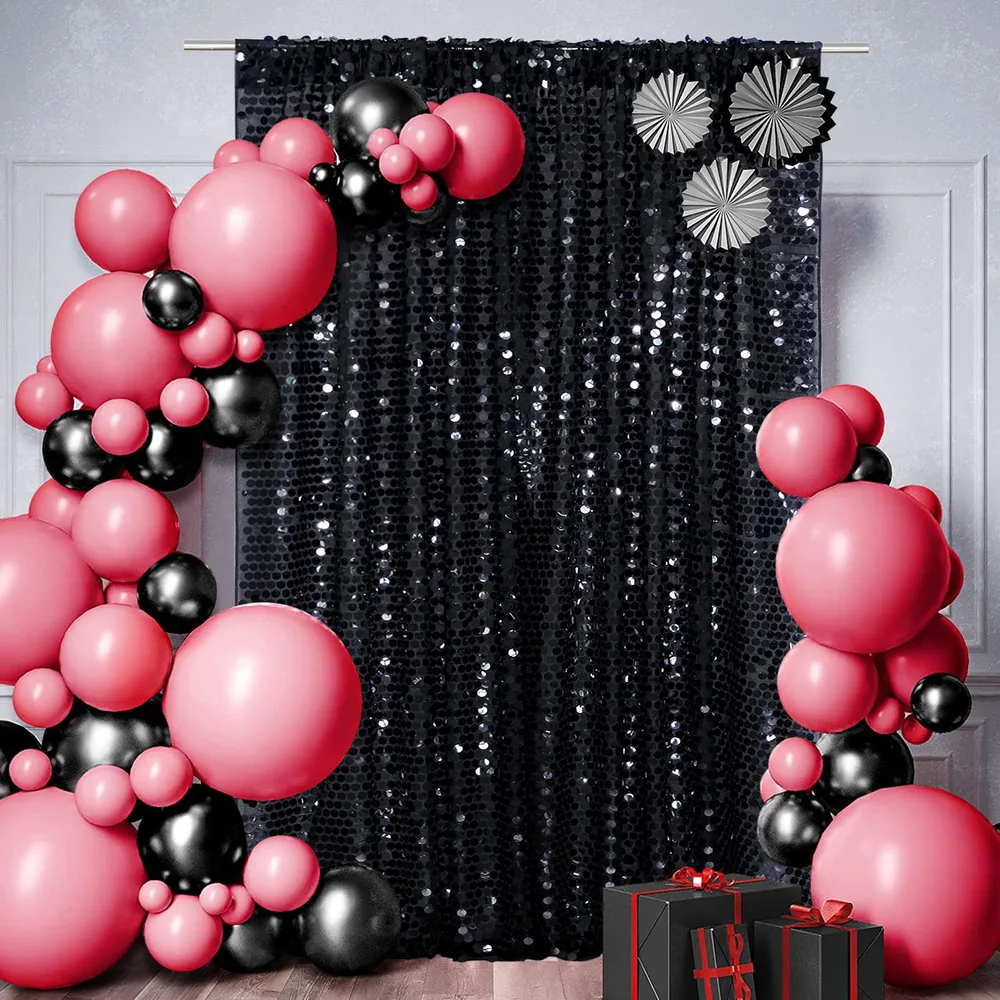
How many panels do I need for an 8ft backdrop?
An 8x8ft backdrop needs 64 panels if your panels are 12 inches (30.48cm), or 81 panels if they are 30cm. The count depends entirely on the panel dimension, because both axes must round up to a whole panel.
Most shimmer wall sizing guides quote 64 panels for an 8x8ft backdrop. That figure is correct — but only for 12-inch panels. It is worth understanding why, because the number changes when the panel does.
Twelve inches is 30.48cm and an 8ft wall is 243.84cm. Those divide exactly: 243.84 / 30.48 = 8 columns precisely, and 8 x 8 gives the familiar 64 panels. The arithmetic is clean because both measurements are imperial.
Our panels are 30x30cm, marginally smaller. Running the same calculation: 243.84 / 30 = 8.13 columns. Panels do not stretch and a grid cannot use a fraction of a panel, so that rounds up to 9 columns. Apply the same logic vertically and you get 9 rows. Nine by nine is 81 panels for the identical 8x8ft wall.
A 0.48cm difference in panel size changes the order by 17 panels. That is the single most useful thing to verify before quoting: confirm the panel dimension in centimetres, then round each axis up independently. A panel count taken from another supplier's guide does not transfer to a different panel size.
How many panels for a 6ft, 10ft or 20ft wall?
A 6x6ft wall needs 49 panels, 8x8ft needs 81, 10x8ft needs 99 and 20x8ft needs 189, based on 30cm panels supplied 24 to a set. The table below gives column and row counts for each.
The table below is generated from the same product data as our catalogue: 30cm panels supplied 24 to a set, covering 23.25 square feet per set. Column and row counts always round up. The set column rounds up again, because sets are not split.
| Wall size | Columns | Rows | Panels needed | Sets to order |
|---|---|---|---|---|
| 6×6ft | 7 | 7 | 49 | 3 |
| 6×8ft | 7 | 9 | 63 | 3 |
| 8×8ft | 9 | 9 | 81 | 4 |
| 10×8ft | 11 | 9 | 99 | 5 |
| 12×8ft | 13 | 9 | 117 | 5 |
| 20×8ft | 21 | 9 | 189 | 8 |
Column and row counts round up to a whole panel; set counts round up again because sets are not split. Figures derived from current catalogue specifications.
Two practical notes. First, order one spare set on any wall above 10ft — panels occasionally arrive with a bent clip and a rental company cannot pause an install to wait for a replacement. Second, the leftover panels from rounding up are not waste; they are the buffer that lets a rental operator run the same inventory across a 6ft and an 8ft booking in the same weekend.
How much does a shimmer wall cost per square foot?
Solid-colour panels run $1.59 each at low volume down to $1.15 at 3000+ panels; patterned finishes run $1.99 to $1.55. Each set of 24 panels covers 23.25 sq ft.
Panel pricing is tiered by total quantity, not by order value, which matters if you are buying several colours at once. Solid-colour panels start at $1.59 each, drop to $1.39 at 500+ panels, and reach $1.15 at 3000+. Patterned and mermaid-finish panels run $1.99 to $1.55 across the same tiers.
Run that through an 8x8ft wall and the arithmetic is straightforward. One wall needs 81 panels, so you order 4 sets — 96 panels — and carry the difference as spares. A single wall does not reach a volume break, but 7 walls do, which is why buyers ordering a mixed-colour range in one purchase order pay materially less per panel than buyers ordering wall by wall. If you are planning a season's inventory, consolidating into one order is worth more than negotiating on any single line.
Should I buy modular panels or a fixed-size backdrop?
Buy modular panels if you serve venues with different ceiling heights; buy a fixed-size backdrop if you always build the same wall. Fixed sizes install faster, panels adapt to any dimension.
Modular panels win on flexibility, but they are not always the right answer. If a client only ever books one wall size, a fixed-size backdrop is faster to install and there is no grid alignment to get wrong. Our fixed-size backdrops run from $49.00 to $199.00 and come in common event formats such as 8x8ft, 10x8ft and 4x7ft.
The decision usually comes down to who is installing. In-house event teams that set up the same stage every week prefer fixed sizes. Rental companies serving venues with different ceiling heights prefer panels, because a 9-row grid can drop to 7 rows for a low-ceilinged function room without buying a second product.
- Fixed size: fastest install, no grid planning, one wall size only
- Modular panels: any wall size, mix colours in one wall, higher panel count on large walls
- Hybrid: fixed stand plus panel infill, useful when the frame is reused and only the surface changes
What do I need to measure before quoting a backdrop?
Measure three things: usable wall width, ceiling height minus any lighting rig, and the floor depth in front of the wall for the stand feet. The third is the one most often forgotten.
Three measurements decide the order: usable wall width, ceiling height minus any lighting rig, and the floor depth available in front of the wall for the stand feet. The third one is missed most often. A freestanding backdrop needs roughly a foot of floor depth behind and in front of the base, and a venue that has already laid a top table 60cm from the wall will not accommodate a rear-braced frame.
For outdoor and marquee bookings, subtract 15-20cm from the stated ceiling height for sag and levelling. It is far cheaper to quote a 7-row grid that fits than an 8-row grid that has to be dismantled on site.
Frequently asked questions
How many panels are in one set?
Each set contains 24 panels of 30x30cm, covering 23.25 square feet of wall. Sets are not split, so order quantities round up to whole sets.
Can I mix colours within one wall?
Yes. Panels attach individually, so ombre gradients and two-tone blocks are built by ordering the colours separately and arranging them on site. Volume tiers are calculated on total panel count, not per colour.
Do panels overhang the frame?
Usually by a few centimetres on the final column and row, because wall dimensions rarely divide evenly by 30cm. The overhang sits behind the frame edge and is not visible from the front.
What is the minimum order?
MOQ is 2 sets or units across the catalogue, which lets a new reseller sample a colourway before committing to a full container.
Need a quote for your project? Send us your target quantity and destination port and we will come back with landed cost, not just unit price.