5 Ways to Mount a Shimmer Wall Without Damaging the Venue
Ask anyone who sets up backdrops for a living what goes wrong most often and the answer is rarely the product. It is the wall. Venues charge for holes, hotels refuse adhesive, and outdoor setups have nothing to fix to at all. Here are five mounting approaches, when each one applies, and the failure mode of each.
Am I allowed to fix a backdrop to the venue wall?
Usually not in hotels and managed venues, which prohibit nails, screws and adhesive on painted surfaces. Confirm in writing before the event and always carry a freestanding option as a fallback.
This single question eliminates most of the options before you start. Hotel ballrooms and managed venues almost always prohibit nails, screws and anything adhesive on painted surfaces, and the deposit deduction for a repaint is larger than the profit on a typical booking. Private homes are usually permissive. Marquees and outdoor sites have no wall at all.
Get the answer in writing before the event, not on the day. A rental operator who arrives with only a wall-mount solution and finds a no-fixings policy has no setup and no fallback. The professionals carry a freestanding option regardless of what the client promised.
How do I hang a shimmer wall with a freestanding stand?
Mount the panels on a telescopic stand that touches nothing but the floor, then weight the base with sandbags. This is the only method that works in every venue type.
A telescopic backdrop stand carries the panels on a crossbar and touches nothing but the floor. It is the only method that works in every venue type, which is why it is the one to buy first even though it is not the cheapest.
The failure mode is tipping. A tall panel wall behaves like a sail, and any air movement — a door opening, air conditioning, an outdoor breeze — applies real force. Weight the base. Sandbags on the feet are standard practice, and on outdoor jobs they are the difference between a setup and an incident.
How do interlocking shimmer wall panels fit together?
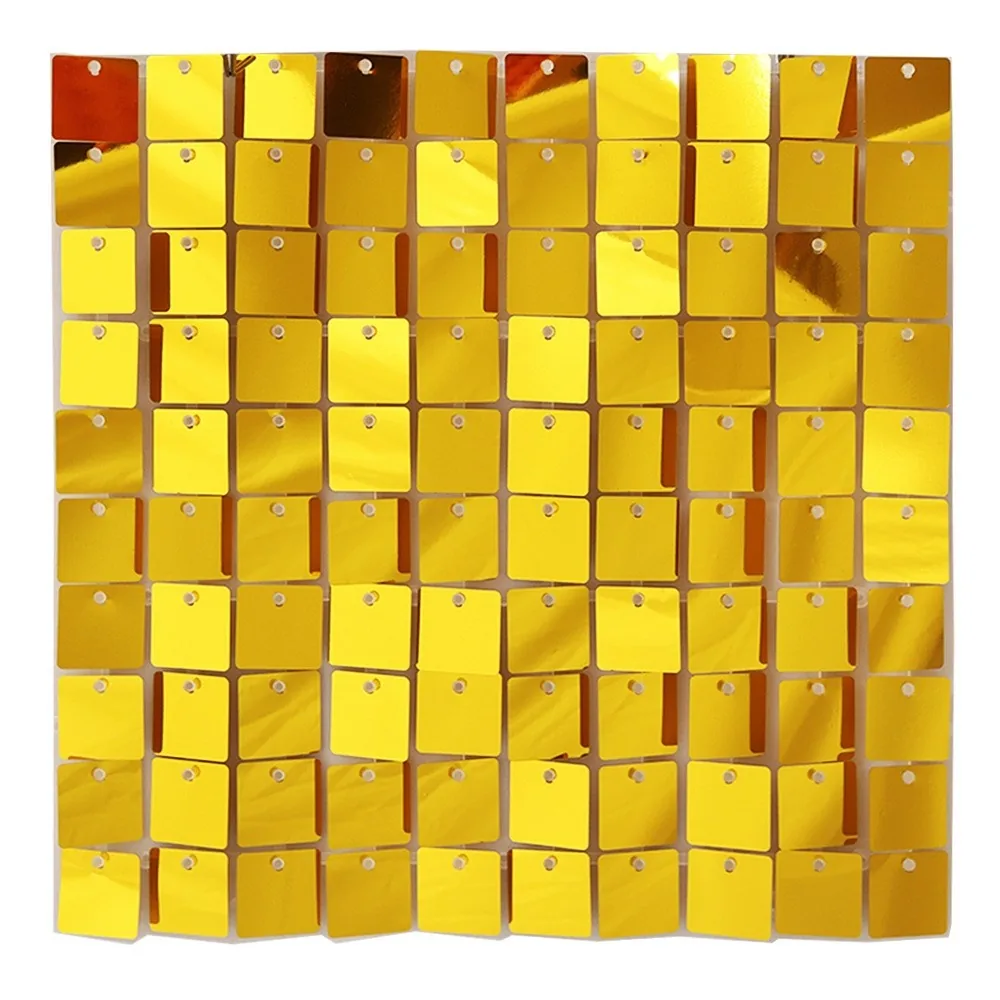
Panels join edge to edge with the clips supplied in each set, forming one rigid sheet rather than 24 separate pieces. Assemble flat on the floor first, then lift the finished grid into place.
Panels join to each other with the interlocking clips supplied in each set, so the wall becomes one rigid sheet rather than 24 separate pieces. That assembled sheet can then be supported by a frame, leaned into a corner or fixed at a small number of points rather than every panel individually.
This is the method that makes large walls practical. Fixing 81 individual panels to a surface is not a realistic install; fixing an assembled grid at its perimeter is. Assemble on the floor first, then lift — assembling in place at height is slow and misaligns easily.
Can I hang a shimmer wall with Command strips?
Yes, on a clean, fully cured, smooth painted wall. Test one strip an hour beforehand, and remove by pulling the tab slowly straight down rather than outward, which is what lifts paint.
Removable adhesive strips are the standard answer for a smooth painted wall where a stand will not fit — narrow corridors, dessert-table backdrops, tight alcoves. They work, with two caveats that catch people out.
First, adhesive strips are rated by weight and the rating assumes a clean, fully cured, non-textured surface. Freshly painted walls, textured wallpaper and matte chalk finishes all reduce grip substantially. Second, removal technique matters more than application: pull the tab slowly and straight down, never outward. Pulling outward is what takes the paint with it.
Test one strip in an inconspicuous spot an hour before committing the whole wall. It costs a few minutes and prevents the one outcome you cannot fix on site.
How do I attach a backdrop to a marquee or truss?
Use cable ties to the existing frame, railing or upright. They are fast, adjustable and leave nothing behind. Use enough ties that no single one carries a concentrated load, and cut the tails flush.
Where there is already a frame, railing, pipe grid, marquee upright or truss, cable ties are fast, cheap, adjustable and leave nothing behind. This is standard practice for exhibition stands and marquee weddings, and it is the method most experienced crews reach for outdoors.
Use enough ties that no single one carries a concentrated load, and cut the tails flush — the protruding tail is what snags fabric and catches the light in photographs. Carry snips; cutting ties with a knife under a dressed wall is how panels get scratched.
- Indoor managed venue → freestanding stand, weighted
- Private home, smooth wall → removable adhesive, tested first
- Marquee, truss or railing present → cable ties
- Outdoors, no structure → freestanding, heavily weighted, and a wind contingency
Can I hang a backdrop from the ceiling?
Only from a structural point the venue has confirmed is rated to carry load. Ceiling tiles, light fittings and decorative beams are not fixing points; if in any doubt, use a freestanding stand instead.
Hanging a backdrop from a ceiling track, beam or truss gives the cleanest look because there is no visible base, and it frees the floor entirely. It is also the method with the least margin for error, because anything suspended over guests is a safety question rather than an aesthetic one.
Only suspend from a structural point that is designed to carry load, and only where the venue has confirmed it. Ceiling tiles, light fittings and decorative beams are not fixing points. If there is any ambiguity about what a fixing is attached to, use a stand instead — the visual improvement is not worth the risk.
What tools should I bring to a backdrop install?
Spare interlocking clips, removable adhesive strips, cable ties and snips, sandbags, and spare panels in your most-used colour. A single damaged panel shows in every photograph and swaps out in seconds.
Experienced operators carry the same small kit on every job because the venue is never quite as described. Spare interlocking clips, removable adhesive strips, cable ties and snips, sandbags, and a few spare panels in the most-used colour. The spare panels matter more than people expect: a single damaged panel in the middle of a wall is visible in every photograph, and swapping it takes seconds if you have one.
The other habit worth adopting is photographing the finished wall before guests arrive. It documents the condition you left the venue in, and it gives you marketing material without a separate shoot.
Frequently asked questions
Can I mount a shimmer wall without any pole stands?
Yes. Panels interlock into a rigid sheet that can be fixed with removable adhesive on a smooth wall, or cable-tied to an existing frame or railing. A freestanding stand remains the only method that works in every venue type.
Will adhesive strips damage a painted wall?
Not if the surface is clean and fully cured and you remove the strip by pulling the tab slowly straight down rather than outward. Test one strip in an inconspicuous area before committing the whole wall.
How do I stop a backdrop tipping over outdoors?
Weight the base — sandbags on the stand feet are standard. A panel wall acts as a sail, so any breeze applies real force. If conditions are gusty, reduce the wall height rather than adding more weight.
Do panel sets include mounting hardware?
Each set includes the interlocking clips that join panels to each other. Wall fixings and stands are separate, because the right choice depends entirely on the venue.
Need a quote for your project? Send us your target quantity and destination port and we will come back with landed cost, not just unit price.