How to Store and Transport Event Backdrops Without Damage
Backdrops rarely fail during an event. They fail in the van on the way back, in a stack against a warehouse wall, or in the fifteen minutes between two bookings when someone is in a hurry. Handling damage is the quietest cost in a rental operation because it never appears on an invoice, it just shortens the life of stock you already paid for.
Should I fold or roll a backdrop for storage?
Roll anything with a printed or continuous surface, and fold only what is designed to fold. A crease across a fabric backdrop shows up under event lighting long after the fabric itself is fine, and it is the most common reason a rental item stops looking sellable.
The distinction that matters is whether the surface is continuous or segmented. Fabric backdrops in the $39.00 to $89.00 range are continuous surfaces: a fold puts a permanent line across the middle of the shot. Modular sequin panels are segmented and rigid, so they stack rather than fold at all.
Rolling needs a core to work. A fabric backdrop rolled loosely onto itself will still develop soft creases where the layers press against each other in a moving vehicle. Rolled around a tube, the tension stays even and the surface arrives flat.
- Roll: printed fabric, continuous cloth backdrops, anything with a smooth face
- Stack flat: modular sequin panels, rigid boards, framed sections
- Deflate and bag: inflatable items, which lose almost all their volume
- Never fold across a printed surface, and never store folded long-term
How do I stop sequin panels scratching each other?
Stack them face to face and back to back, so the sequin surfaces never meet a hard clip. The damage on shimmer panels almost never comes from the sequins themselves; it comes from the interlocking clips on the reverse of the next panel pressing into the face during transit.
This is worth being specific about because it is counter-intuitive. Operators carefully separate every panel with tissue and still get marks, because a stack of 24 panels in a moving van generates pressure at exactly the points where the clips sit. Pairing faces together means clip meets clip, and the sequin surfaces only ever touch each other.
An 8x8ft wall is 81 panels, so a full booking is a substantial stack. Split it across two shorter stacks rather than one tall one: the panels at the bottom of a single tall stack carry the whole load, and that is where marking starts.
What is the best way to transport a flower wall?
Carry flower walls flat and face up, never on edge. Silk blooms on a mesh base recover from compression but not from being crushed sideways, which bends the stems at the point where they enter the mesh.
The failure mode is specific: a panel stood on its edge in a van puts the entire weight of the panel onto the bottom row of flowers. Those blooms flatten, and unlike a compressed surface they do not spring back because the stem itself has kinked. One badly stowed journey can visibly age a wall that has only been to two events.
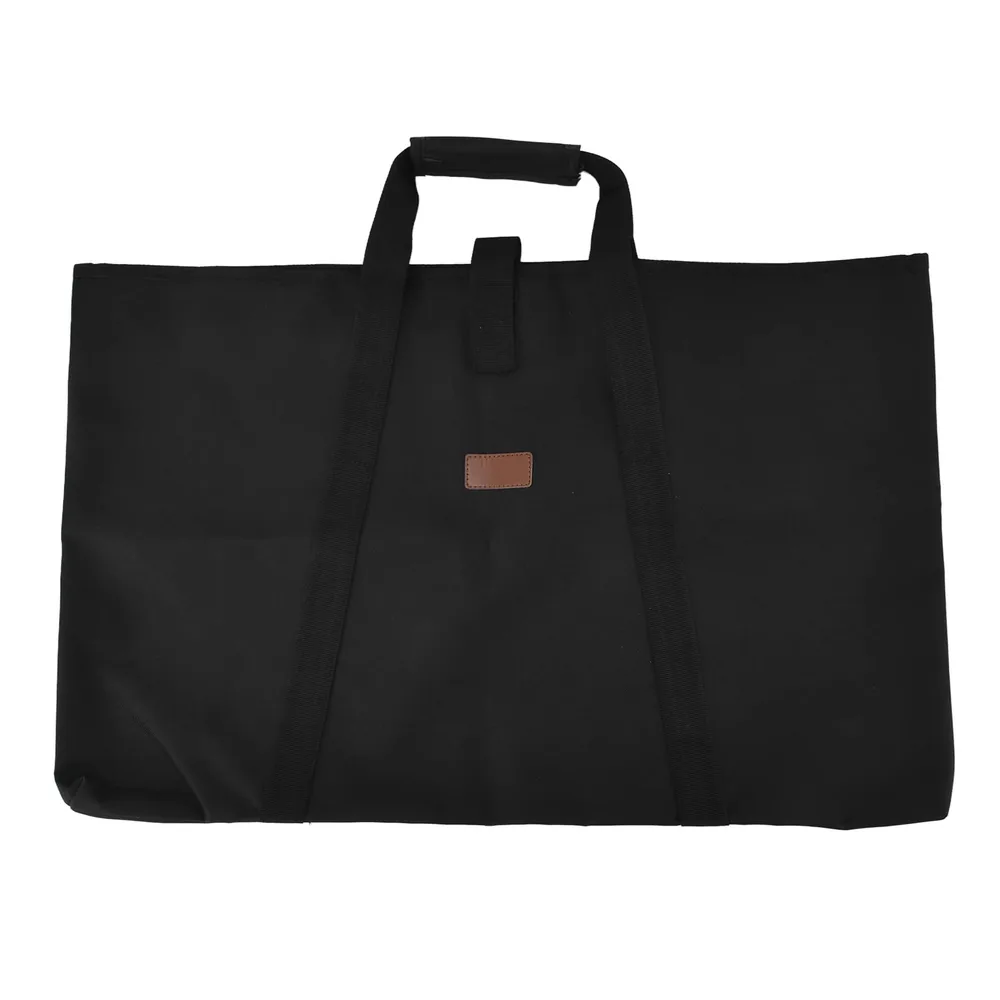
A purpose-made carry bag is the cheapest protection in the category. Our oxford carry bag is $29.00, against flower walls at $129.00 to $179.00 across 13 designs. It is a small percentage of the item it protects, and it also solves the secondary problem of loose petals collecting in the van.
In what order should I load a van for a backdrop booking?
Load in reverse order of use: the first thing you need on site goes in last. Stands and frames come out first at the venue, so they should be nearest the doors, with panels and dressing behind them.
This sounds obvious and is routinely ignored under time pressure, which is how panels end up being unloaded onto wet ground to reach a stand buried at the front. The ordering rule is not about tidiness, it is about never having to put stock down somewhere unplanned.
The second rule is that rigid items form the structure of the load and soft items fill the gaps, not the reverse. Frames and stands laid flat create a stable floor; rolled fabric and bagged inflatables go on top. Loading soft items first means everything above them shifts on the first corner.
- Last in, first out: stands and frames nearest the doors
- Rigid items form the base layer, soft items fill above
- Deflated mirror balls and bagged fabric absorb movement, so use them as padding
- Nothing loose: an unsecured panel becomes a projectile under braking
How should inflatable decor be packed between events?
Deflate fully, let it dry, then bag it loosely. The volume advantage of inflatable stock is the reason to carry it, and a mirror ball that goes back into the van still inflated has given up its main commercial benefit.
Drying matters more than most operators expect. An inflatable packed damp from an outdoor event develops surface marks on the mirrored film that do not clean off, and the film is the entire product. Ten minutes of air-drying before bagging protects an item that costs $79.00 to $129.00.
Bag loosely rather than compressing hard. Tight compression creases the film along fixed lines, and those lines stay visible when the item is re-inflated, which is exactly the kind of defect a client photographs and queries.
How do I turn stock around between two bookings in one day?
Keep a second set of the consumable parts, not a second backdrop. Same-day turnaround fails on small items — clips, ties, sandbags, spare panels — far more often than on the main product.
The practical approach is a fixed kit box that never gets unpacked into general storage. When strike and load-in are separated by two hours, there is no time to hunt for a bag of clips, and the cost of duplicating those consumables is trivial against a missed booking.
Panels bought in sets support this naturally. A wall needs 81 panels and sets ship 24 to a set, so ordering 4 sets leaves surplus that lives permanently in the kit box as replacements. At $1.59 a panel with a minimum of 2 sets, holding spares costs less than one damaged booking. For how these handling costs feed into pricing, see our guide on costing a rental booking.
Frequently asked questions
Should backdrops be folded or rolled for storage?
Roll anything with a continuous printed or fabric surface, around a tube rather than onto itself. Stack modular sequin panels flat. Never store a fabric backdrop folded, because the crease line shows under event lighting.
How do I stop shimmer wall panels getting scratched in transit?
Stack them face to face and back to back so the interlocking clips on the reverse never press into a sequin surface. Split large orders into two shorter stacks rather than one tall one.
What is the safest way to transport a flower wall?
Flat and face up, never standing on edge. Silk blooms recover from compression but not from bent stems, and a panel on its edge puts the whole weight onto the bottom row of flowers.
Do inflatable mirror balls need to be dried before packing?
Yes. An inflatable packed damp develops marks on the mirrored film that do not clean off. Deflate fully, air-dry for a few minutes, then bag loosely rather than compressing it hard.
Need a quote for your project? Send us your target quantity and destination port and we will come back with landed cost, not just unit price.